Not Just Places You Catch Trains
You can learn a lot about a country by standing in its train stations. Not the ticket counters or the departure boards — I mean the buildings themselves. The stonework, the grand halls, the bits of forgotten art wedged into alcoves nobody looks at anymore. Spain? Spain does stations properly.
Sue calls them my cathedrals. And she’s not wrong.
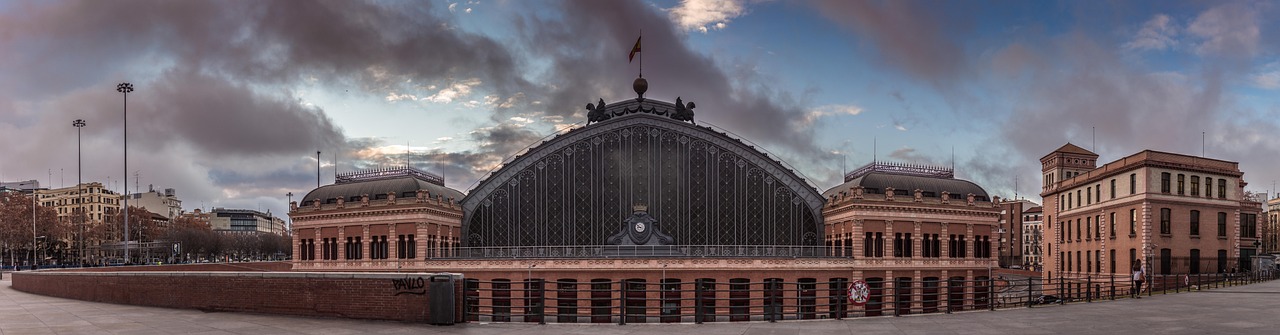
Madrid Atocha: The Jungle in the City
You walk inside Atocha and the first thing that hits you isn’t the size or the crowds. It’s the trees. Real ones. An actual tropical garden under a vast glass canopy. Palms, ferns, ponds full of turtles — all slap bang in the middle of Madrid’s busiest railway terminal.
Atocha opened in 1851 but has been rebuilt more times than either of us can count. The old iron-and-glass terminal is now part conservatory, part waiting room, part urban oasis. The high-speed AVE trains depart from newer platforms, but I always make Sue linger in the old part. “You don’t get turtles in Crewe,” I remind her.
She pretends not to hear.
Valencia Estació del Nord: Art Nouveau on the Platform
If you could turn a railway station into a jewellery box, you’d get Valencia Estació del Nord. Opened in 1917, it’s an Art Nouveau masterpiece. The façade is tiled with orange blossoms, bats, and Valencian flags — pure regional pride baked into every square inch.
Inside, the ceramic mosaics, stained glass, and polished woodwork feel like walking into a film set. Even the ticket counters have delicate carvings. “It’s pretty,” Sue admits. “Though you’d stare at a manhole cover if it had a rivet on it.” Fair point.
Canfranc International: The Grand Ghost
Then there’s Canfranc.
If you want eerie, magnificent, and slightly absurd, this is it. Tucked away in the Aragonese Pyrenees, Canfranc once dreamt of becoming Europe’s grand rail gateway between Spain and France. It opened in 1928 with 365 windows (one for every day of the year), endless platforms, customs offices, and ballrooms. Kings visited. So did spies during WWII.
Then it fizzled. The cross-border link collapsed in 1970 after a French bridge was damaged. The station sat abandoned for decades, its vast façade slowly surrendering to time.
We visited just as restoration was underway. There’s talk of reviving international services again. Standing there, you feel the ghosts of ambition lingering in every echoing corridor.
“It looks like something out of an old spy film,” Sue whispered as we stared up at its endless rows of shuttered windows. She wasn’t wrong. Canfranc makes most stations look timid.
More Than Platforms
Spain has dozens more stations that could make this list — Zaragoza’s modern steel behemoth, Bilbao’s stained-glass fronted Concordia, even smaller gems like Almería or Toledo. Each one a blend of engineering and storytelling.
I don’t just collect tickets. I collect stations.
Next Up
After marvelling at these living museums, we’re heading south again — into Andalusia, where rails snake through history and the landscapes start to feel like film sets themselves.
No responses yet