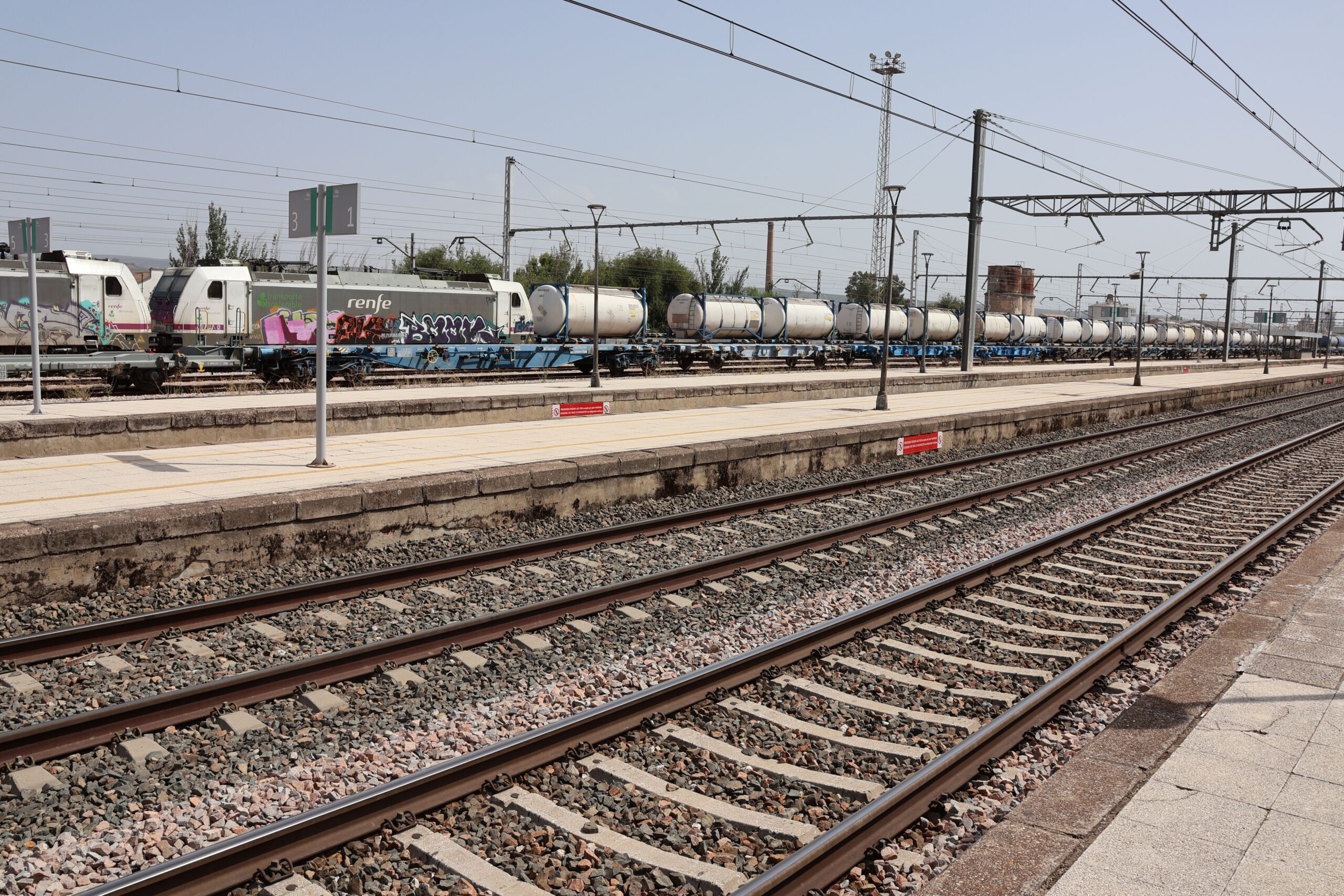
The last time we visited Geoff and Carol outside Lleida, Geoff had settled comfortably into semi-off-grid retirement. He was still building things that did not need building and repairing anything that stayed still for long enough. Sue had been asking when we were going back, mainly because she enjoys Carol’s company and considers three hours beside a railway line an unreasonable price for lunch.
We drove over on a warm Thursday morning. Lunch was the stated plan, although plans have never survived long around Geoff.
Before midday we were standing beside a freight line outside town. Geoff had noticed a locomotive in the distance and was already trying to identify it. At that range I could barely tell there was a train approaching.
“DB Cargo,” he said. “Mixed freight. Heading north.”
Several minutes later it passed us. He was right on all three counts.
The same thing happened with the next movement. Geoff recognised the operator and then moved on to the wagons, explaining what they carried and why their design had changed. I could follow some of it, although he had moved well beyond my knowledge by the time the final wagon passed.
That is the difference between railway people and everyone else. Most passengers see a train. Someone who has spent years around railways notices the locomotive class, wagon arrangement, couplings, brakes and a dozen smaller details that are easy to miss. Much of that knowledge stays lodged in the mind long after the job itself has finished.
By lunchtime it was clear that Geoff could identify a freight movement more easily than he could operate his phone.
Carol had asked him to show us some photographs from a recent trip. He opened the wrong application, followed it with the weather forecast and somehow changed the language settings. Catalan appeared on the screen. Nobody knew how it had happened and Geoff was unable to repeat the manoeuvre when challenged.
“You had the photograph open two minutes ago,” Carol told him.
“I did not.”
“You did.”
While they argued, Sue gave me the look that meant I was not to offer technical assistance. This was sensible because I would probably have made matters worse.
The phone eventually went back into Geoff’s pocket and the conversation returned to freight. He explained why it still interested him when passenger trains receive nearly all the public attention. People notice stations, departure boards and the train carrying them to Madrid. They rarely think about the containers, cars, steel and food moving across the same network.
It took me back to the freight yard in Night Freight. Much of the railway’s useful work happens without passengers seeing it. A freight train passes through the background while attention remains fixed on the platform.
After lunch Geoff resumed his explanation of wagon types. Sue and Carol moved their chairs slightly farther away and left us to it. By mid-afternoon we had covered operators, liveries and several disagreements about locomotives neither of us had worked on.
As we left, Geoff called after us with another observation about a locomotive he had seen the previous week. I missed part of it, although that did not matter. He was already halfway through the explanation and looked perfectly content.
His phone may remain a mystery to him. Put a freight locomotive on the horizon and the old knowledge returns before the train is close enough for the rest of us to see the badge.
Related Articles
No responses yet